.png)

The Brexit Effect: An Overview
On June 23rd 2016, the UK voted 52% to 48% in a referendum to leave the European Union in a move known as ‘Brexit’. The country officially left on December 31st 2020, and since then, there has been a measurable shift in how UK and EU fashion businesses trade with one another.
Exclusive transaction data from JOOR reveals:
- EU brands grew significantly: their sales volume tripled between 2017 and 2025, driven mainly by retailers within the EU and Rest of World (ROW)
- EU retailers' spend shifted away from the UK: from 17% of purchases in 2017 to less than 7% in 2025
- UK retailers moved away from EU brands: share of purchases dropped from 51% in 2020 to 29% in 2025
- UK brands saw less dramatic impact: a slight decline in ROW share of sales was offset by UK retailers’ share rising from 18% in 2021 to 23% in 2025
The 10 Years Post Brexit
When the UK voted for Brexit in 2016, there was a cloud of uncertainty surrounding European Union trade relations, customs barriers, and increased administration. But how does the wholesale landscape look 10 years on?
When comparing the full year from 2017 to 2025, overall sales volume for UK brands on JOOR grew 48%, whereas non-UK brands grew 129% in the same period. When it comes to retailers, UK retailers’ overall purchase volume on JOOR grew 39%, whereas non-UK retailers grew 128% in the same period. These figures indicate that the growth of UK brands and retailers during this timeframe did not keep pace with their global counterparts.
As the fashion industry’s leading wholesale management ecosystem, with data from more than 14,000 brands and 700,000 curated fashion buyers across 150 countries, we’ve conducted an in-depth analysis of JOOR wholesale trade data post-Brexit decision to find out exactly how brands and retailers have been affected.
We’ve collated our findings into this insights report, so read on to discover what our exclusive data reveals and how you can use this knowledge to spearhead growth for your own wholesale business, no matter where you are based.
EU Brands Boom Post Brexit

The share of EU brands’ sales attributed to UK retailers fell dramatically from 12% in 2017 to less than 4% in 2025; however, EU brands’ overall sales volume on JOOR more than tripled during this period, with growth driven almost entirely by retailers within the EU and the ROW.
Brexit seems to have caused EU brands to focus on increasing sales within the region. While EU brands are now generating billions more than they were pre-Brexit, the UK is steadily getting a smaller and smaller slice of their overall sales.
Key Takeaway for Brands
EU brands are highly sought after and tend to be selective about which retailers they choose to work with. New enhancements to JOOR retailer profiles mean brands can now see data on which other brands retailers carry, which categories they buy from, and how many years they have been active on the platform, making it easier to choose partnerships that align with your business goals.
Key Takeaway for Retailers
Investing in brands from the EU region could represent an opportunity for your business. Read our reports on the Italian and French markets to better understand how you can strategically add new brands from this area to your assortment to drive growth, no matter where your retail stores are located.
EU Retailers Shift Away From UK Brands

Since the announcement of Brexit, EU retailers have moved away from UK brands and have made up for this by shifting their investment into EU brands. In 2017, UK brands made up 17% of EU retailers’ overall purchases, whereas this dropped to under 7% in 2025. During this same time period, the portion allocated to EU brands increased from 54% to 69% of their investment.
EU retailers are most likely favoring continental fashion as UK fashion becomes more expensive for them to obtain due to cross-border logistics. When building assortments, they will also be conscious of their customers. Consumers looking for luxury fashion in particular may be more likely to purchase EU brands post-Brexit, as there is no additional VAT cost.
Key Takeaway for Brands
As European retailers have dedicated less share of their buy to UK brands, there is an increased opportunity for brands from the rest of the world. Use the Find New Retailers filter to discover stores in Europe that could be a good match for your brand.
Key Takeaway for Retailers
As a large majority of European retailers shift their assortment towards EU-based brands, there is an increased chance of product overlap with competitors. Ensure your product mix is as diverse as possible and try to negotiate store-exclusives with brands for the best chance at attracting customers.
UK Retailers U-Turn on EU Brands
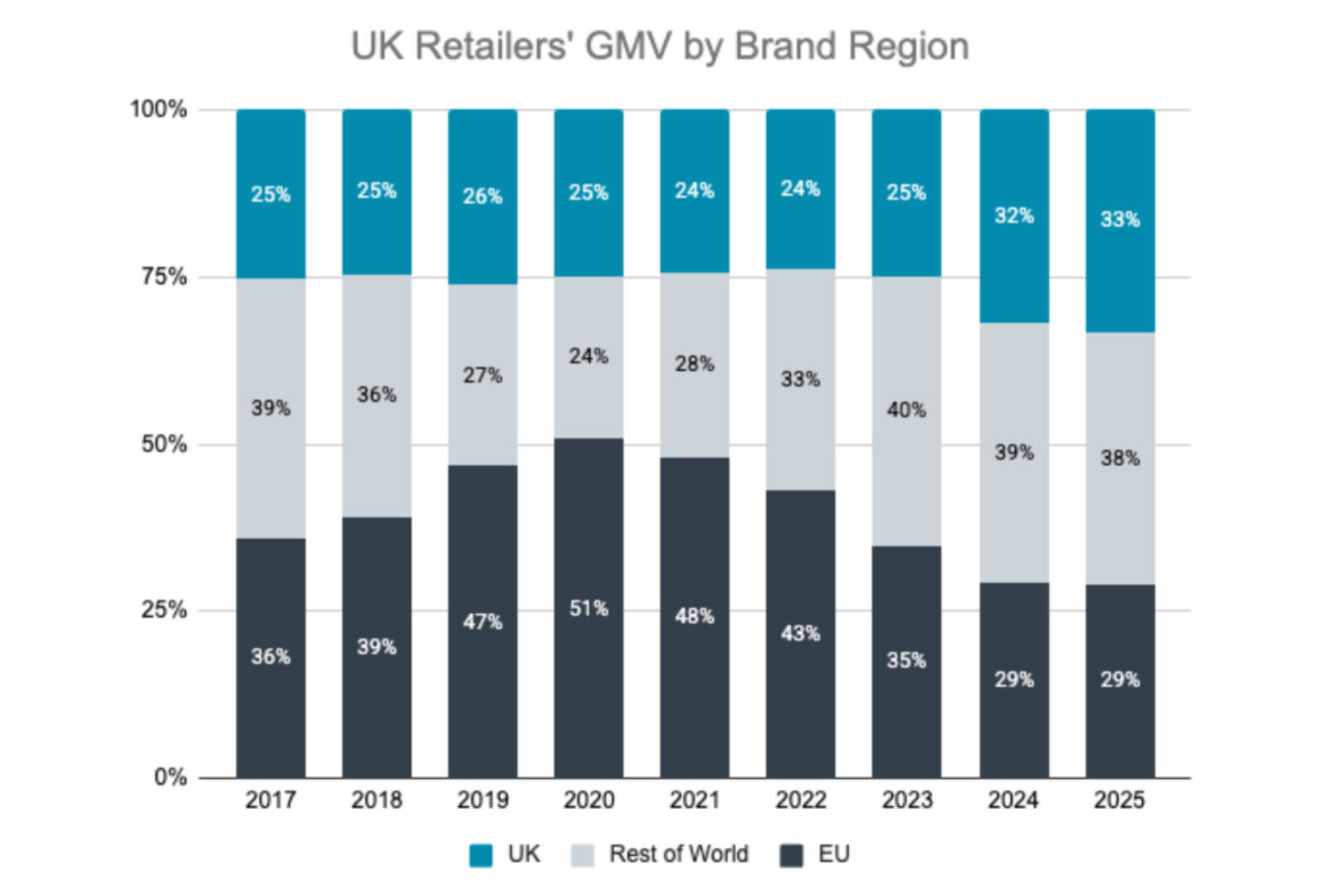
UK retailers have moved away from EU brands since Brexit went into effect at the end of 2020. From 2017 to 2020, UK retailers were steadily increasing the portion of their buy that went to EU brands, but since then, this share has dramatically decreased from 51% in 2020 to 29% in 2025. This shows a clear correlation with the increased cost of importing goods.
Post-Brexit, goods originating in the EU can be imported to the UK at zero tariff with no customs duty, but if a product was originally manufactured outside of the EU, which is often the case with fashion garments, third-country customs apply.
UK retailers are seemingly not willing to pay these additional fees and have instead increased the portion of their buy from ROW and homegrown brands.
Key Takeaway for Brands
If you are a brand based outside of the EU, consider expanding into the UK market. Contact UK retailers of interest using JOOR’s AI-informed personalized prospecting outreach feature, and be sure to include any attractive information regarding your duties and shipping fees so they can get a clear picture of your import cost vs EU brands.
Key Takeaway for Retailers
UK retailers can leverage JOOR to connect with some of the most notable British fashion brands, including Erdem, Victoria Beckham, Vivienne Westwood, and Simone Rocha.
UK Brands Held Steady

While slight adjustments are apparent, UK brands have not seen as dramatic a shift in the makeup of their distribution post-Brexit as has been experienced by EU brands. From the end of 2020 onwards, there has been a slight decline in ROW retailers and a shift towards UK retailers, with UK retailers’ share increasing from 18% in 2021 to 23% in 2025, but EU retailers account for approximately the same portion of sales today as they did ten years ago (remaining in the range of 28-32% of total sales).
This could, in part, be due to the fact that EU consumers are loyal to UK brands, despite the increased prices and longer delivery times. It could also reflect the fact that many UK brands made modifications to their supply chain in a speedy manner when Brexit was announced.
A number of fashion brands moved part of their operations overseas, opening warehouses in Germany, the Netherlands, and Poland, to avoid paying additional customs fees.
Key Takeaway for Brands
UK-based brands should clearly communicate with retailers if they have overseas warehouses, as this can be a huge selling point when trying to win new business with European retailers.
Key Takeaway for Retailers
Evaluate whether shoppers are showing a continued interest in UK brands. If so, consider if there are any new or additional fashion labels from the region that you could add to your assortment to pique their interest and increase footfall.
How JOOR Can Help You Succeed Post-Brexit
Our insights show that brands and retailers across the UK and the EU can use JOOR to accelerate their wholesale growth and navigate global trade dynamics.
Using proprietary data, matchmaking tools like JOOR Discover, and AI-informed prospecting, our technology continues to help fashion businesses cross borders and build lasting business partnerships both domestically and around the world.
Brands - Spearhead your growth today with JOOR. Request a demo.
Retailers - Open a free JOOR account and start discovering new brands now.
*Analysis reflected in graphs based on data from Feb 2017 to May 2026.
.avif)

Discover the Top 5 Trends in Wholesale for 2026
Related Insights

How to Measure Trade Show ROI: A Complete Guide to Calculating Event Success
Learn the key metrics that will help you determine whether your in-person wholesale activities are a success and discover how to track long-term progress.

Why Digital B2B Catalogs are Essential for E-Commerce Businesses
Online catalogs have become a crucial component for retailers and their buyers in an evermore tech reliant industry. Read about how these dynamic product libraries act as comprehensive selling solutions that plug into current buying behaviors.
%2520(2)%2520(1).avif)
8 Ways a B2B Fashion Marketplace Solves Wholesale Scaling Challenges
Learn how a B2B fashion marketplace like JOOR helps your wholesale fashion brand overcome scaling challenges. Maximize resources, build retailer relationships, and enhance distribution to drive growth in the global wholesale fashion market.

2026 Fashion Trend Report
Uncover the must-know fashion trends due to be released throughout 2026 with JOOR's exclusive Fashion Trend Report. Dive into each seasons styles and shop the collections on JOOR Passport - where runway inspiration meets wholesale buying.

Top 5 Trends in Wholesale for 2026
Future-proof your fashion business with our wholesale trends forecast. Explore the industry shifts, buying patterns, and brand behaviors we predict will shape the industry in 2026 and learn data-driven industry insights with our free-to-download Wholesale Trends 2026 whitepaper.

French Market Analysis: Insights to Prepare You for Next Season
Discover new opportunities in the French wholesale fashion market thanks to JOOR’s exclusive transaction data, and use our findings to inform your growth strategy for the coming season.