

Increasing wholesale AOV (average order value) is a key concern for fashion brands looking to scale. To do this correctly, brands must first identify what’s limiting orders, then improve the buying process to fix it - however it’s important to distinguish that larger orders are only more valuable when the assortment fits the retailer, protects margins, and sells through.
Measure AOV Against the Metrics That Explain It
Wholesale AOV = wholesale revenue ÷ order count
Average order value can indicate profitability by giving an approximation of how much buyers spend per order, but it should also be measured against other metrics to give a complete picture of how a fashion brand is performing.
Comparing AOV with units per order or product mix metrics helps brands better understand if buyers' carts are being inflated by low- or high-margin items.
Comparing AOV with gross margin helps brands figure out how much revenue they actually keep per order, while comparing AOV and reorder rate makes it easier to spot if your MOQs are too high.
A high AOV doesn’t always mean business is thriving. Compare AOV with sell-through rate and inventory exposure to see how much stock is actually on shelves, and how much is sitting in your warehouse, potentially going to waste.
Fashion brands using a B2B platform should segment their AOV data by retailer, region, season, category, account stage, opening order, and reorder where possible to get the most accurate information on their wholesale performance.
Find the Constraint Before Choosing the Tactic
Fashion brands should use AOV data to distinguish the root cause of their order value limitations. This could be incomplete assortments, weak product fits, an unsuitable minimum, missed reorders, or a margin problem. Even if you have a low AOV across all buyers, do not assume that these all stem from the same issue.
A small boutique store in the suburbs may have problems with cash flow that prevent them from placing higher-value orders with you, whereas a large department store with over 100 retail locations around the country might have a low AOV because you gave them too big of an initial discount to get stocked in their stores.
Always confirm that you have correctly identified the root cause of the AOV first before looking to solutions.
Improve Assortment Fit Before Pushing More Product
An assortment can majorly affect AOV. Fashion brands should carefully study buyer history, retailer type, regional demand, season, and store context to ensure that they are showing buyers the right products for the types of assortments they are building.
Identifying high sell-through rates and bestsellers will always point you in the right direction so that you can begin creating highly curated and personalized selections that best suit your target buyers.
Complementary product groups can improve AOV as they can help retailers fill gaps in their assortment or complete a look. However, with all products, these should be showcased in a considered way.
Forget digital linesheets and virtual showrooms filled with every possible SKU, and instead focus on highly curated product lines that have an almost editorial feel and will help buyers build complete outfits for their customers. Avoid unrelated bundling or discount-led linesheets, as these will hinder AOV rather than help it.
How JOOR is a Platform That Enables AOV Growth
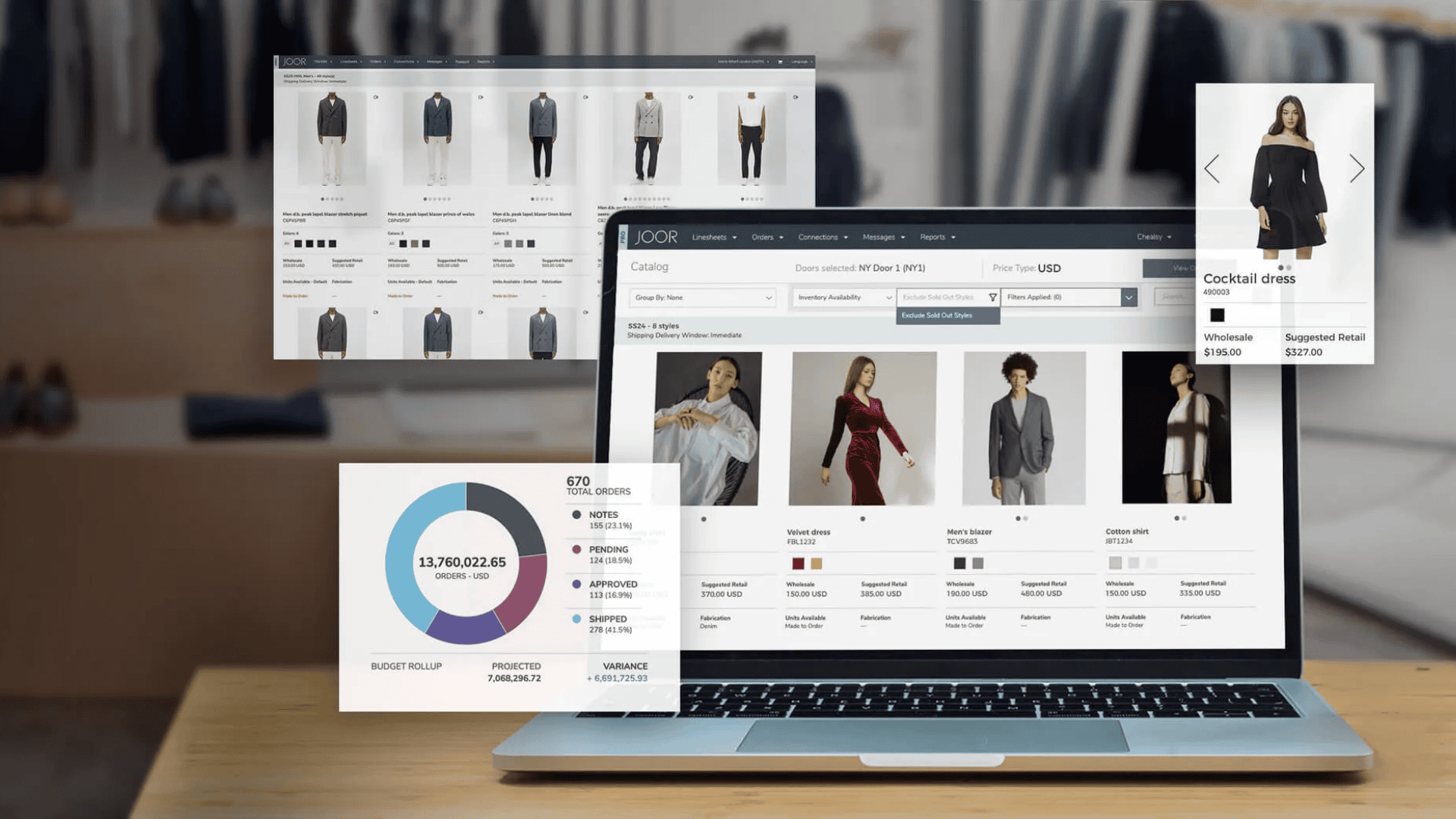
Unlike static spreadsheets, JOOR's shoppable linesheets offer buyers an ecommerce-like experience, allowing them to add SKUs to their cart in just a few clicks.
They also include high quality imagery that allows buyers to zoom in and really see every detail of a garment, making it much easier to sell higher priced items.
Use JOOR linesheets to display highly curated collections in the most effective way, and group them by price point or specific retailer for the best chance of raising AOV.
Use MOQ & MOV to Set a Profitable Order Shape
Minimum order quantity (MOQ) refers to the lowest number of units a brand will sell to a retailer. Sometimes brands will set MOQ for specific styles.
Minimum order value (MOV) refers to the lowest spend required by a retailer to place an order.
To ensure a healthy AOV, brands should set MOQ and MOV thresholds based on break-even costs, production requirements, and historical order sizes, as well as retailer economics and account stage. Thresholds for MOQs and MOVs should be used to protect margins and prevent buyer friction whenever possible.
MOQs and MOVs may need to be adjusted for an initial retailer order to allow a buyer to test new products with customers, but this should only be done when there is clear benefit to being stocked in their store.
Once a retail relationship has been established between brand and buyer, MOQs and MOVs may need to shift again for reorders, but this should only occur once trust has been built.
Use Reorder Evidence to Build the Next Order
To drive higher wholesale AOV, fashion brands should review their sell-through rates, stock gaps, prior order composition, reorder timing, and product performance data before suggesting replenishment or expansion to a retailer.
Brands should work on replacing products with proven demand first before suggesting new items to buyers. Relevant products should only be introduced when the evidence supports it, so that the suggestion feels like a natural and organic progression of your retail relationship rather than a hard cross-sell.
The timing of a reorder can also affect the AOV. Brands should pay close attention to seasonal trends so that reorder reminders feel more like useful recommendations for buyers than thoughtless sales prompts.
Again, this should not be about forcing additional and unnecessary units onto buyers but instead helping them to enhance their assortments with thoughtfully curated picks that are tailored to their needs.
Judge the Outcome by Order Quality, Not AOV Alone
Average order value alone is not a true marker of success. Fashion brands should also look at how they are supporting sell-through, gross margin, inventory health, retailer fit, and repeat ordering.
Sometimes a lower-AOV order may actually be commercially stronger when it is better matched and more likely to lead to reorders. Think about the lifetime value of your retail relationships, not just orders in isolation.
For brands that are still keen to drive higher AOV, remember the key principles explained in this article. First, measure the results of your business and analyze key data to find your AOV; next, identify where the root cause of your buying issue lies; and then apply one focused change in the next selling cycle and track the progress.
By following these steps, you should see an improvement in your fashion brand’s AOV. For further assistance in wholesale success, request a demo of JOOR today.
FAQs
What is AOV in wholesale fashion?
AOV stands for average order value, and in wholesale fashion refers to the amount of money a retailer spends each time it places a wholesale order with a brand.
How do fashion brands calculate wholesale AOV?
Fashion brands calculate wholesale AOV by dividing their wholesale revenue by their order count.
How can assortment planning increase wholesale order value?
Better assortment planning leads to increased wholesale order value because if brands show buyers products that are tailored to their customers' needs, then those buyers are more likely to order more products. Brands can also improve AOV by offering buyers complementary product groups to fill gaps in their assortments.
What is the difference between MOQ and MOV?
Minimum order quantity (MOQ) refers to the smallest possible number of items a retailer must purchase from a brand, while minimum order value (MOV) refers to the minimum price a retailer must spend with a brand to be able to place an order.
Should wholesale brands use bundles or discounts to increase AOV?
To increase AOV, wholesale brands should offer retailers bundles rather than discounts. Bundles can help to sell slow-moving inventory and give overwhelmed buyers the chance to purchase ready-made selections of multiple products in one order, pushing up AOV, whereas discounts generally eat away at profit margins, lowering AOV.


Discover the Top 5 Trends in Wholesale for 2026
Related Insights

How to Measure Trade Show ROI: A Complete Guide to Calculating Event Success
Learn the key metrics that will help you determine whether your in-person wholesale activities are a success and discover how to track long-term progress.
A Lookback on 2025 at JOOR
Reflect on the insights and innovations JOOR brought to the wholesale industry in 2025, from launching a new first-of-its-kind solution to expanding our global network of fashion brands and retailers.

Why Digital B2B Catalogs are Essential for E-Commerce Businesses
Online catalogs have become a crucial component for retailers and their buyers in an evermore tech reliant industry. Read about how these dynamic product libraries act as comprehensive selling solutions that plug into current buying behaviors.
How Centralized Order Management Prevents Missed Reorders
Discover how your fashion wholesale business can use OMS software to reduce errors, improve inventory visibility, and streamline operations.
How Fashion Brands Sync Inventory, Orders, and Finance Using ERP Systems
Learn how an ERP system could help your fashion brand streamline its wholesale workflow and bring all areas of the business together with a centralized system.

Improving Wholesale Order Accuracy in Fashion with Data Analytics
Learn how digital order capture helps fashion brands spot recurring wholesale errors faster and how understanding analytics and reporting can save fashion businesses time and money.